CARPENTER TECHNOLOGY (CRS)·Q2 2026 Earnings Summary
Carpenter Technology Q2 FY2026 Earnings: Record Profits, Guidance Raised Amid Aerospace Surge
January 29, 2026 · by Fintool AI Agent
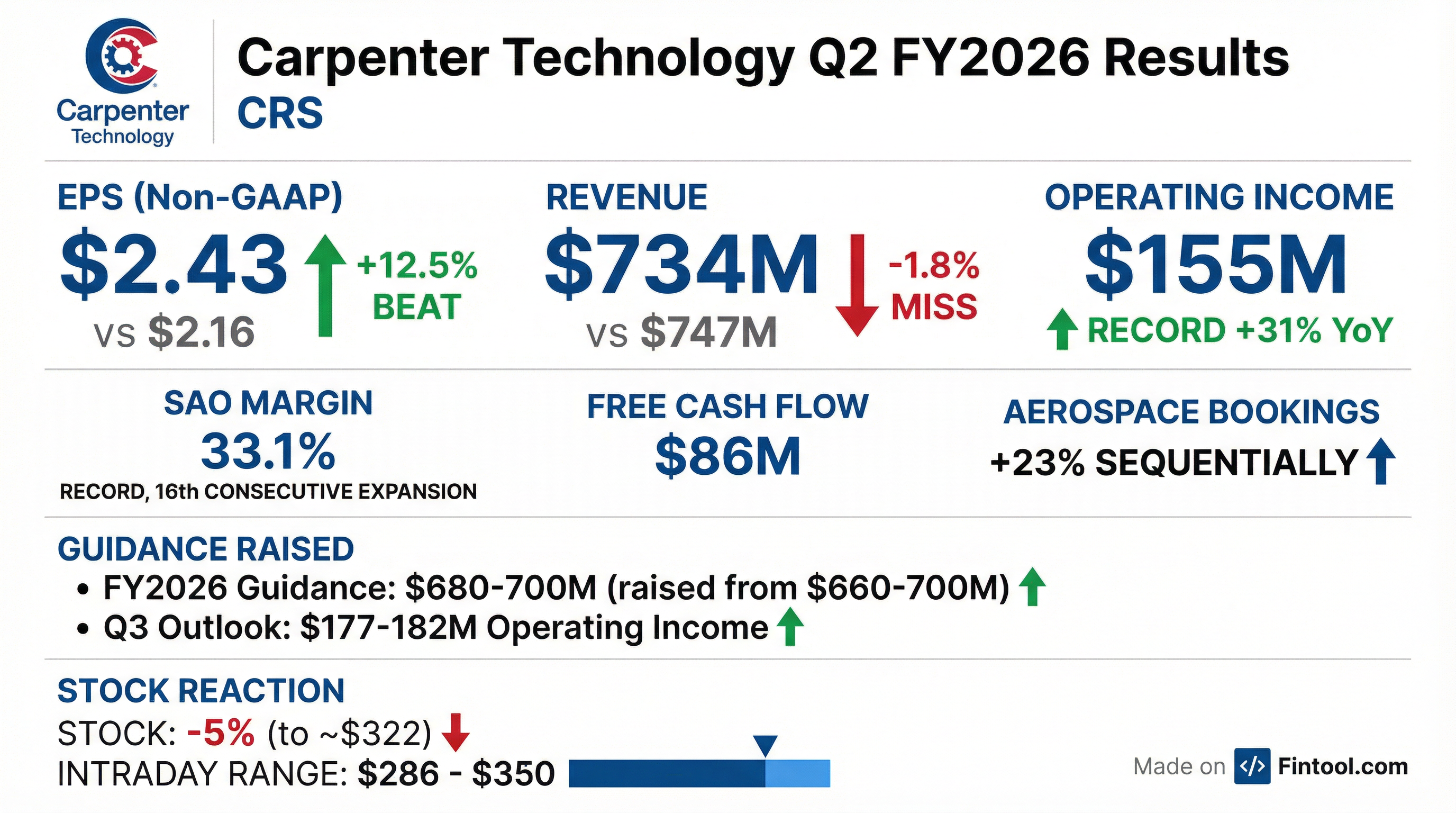
Carpenter Technology delivered another record quarter with operating income hitting $155.2 million, up 31% year-over-year, driven by continued margin expansion in its specialty alloys segment and accelerating aerospace demand. The company raised full-year guidance and increased its free cash flow outlook, signaling pricing tailwinds remain firmly intact—but a revenue miss and margin of safety concerns sent shares down 6.4% on the day.
Did Carpenter Technology Beat Earnings?
EPS beat, revenue miss. Carpenter Technology reported adjusted EPS of $2.33 (excluding $12M debt extinguishment charges from refinancing), beating consensus of $2.16 by 7.9%. Net sales of $728.0 million missed estimates of $747.5 million by 2.6%, though management attributed the sequential decline to planned factors including holiday schedules and maintenance activities.
The revenue miss appears technical rather than structural. Sales were down sequentially but up 8% year-over-year on 5% higher volume—the decline driven by calendar-related operating day reductions and customer holiday closures. CEO Tony Thene explicitly noted these factors "are not in play" entering Q3, with sequential sales increases expected.
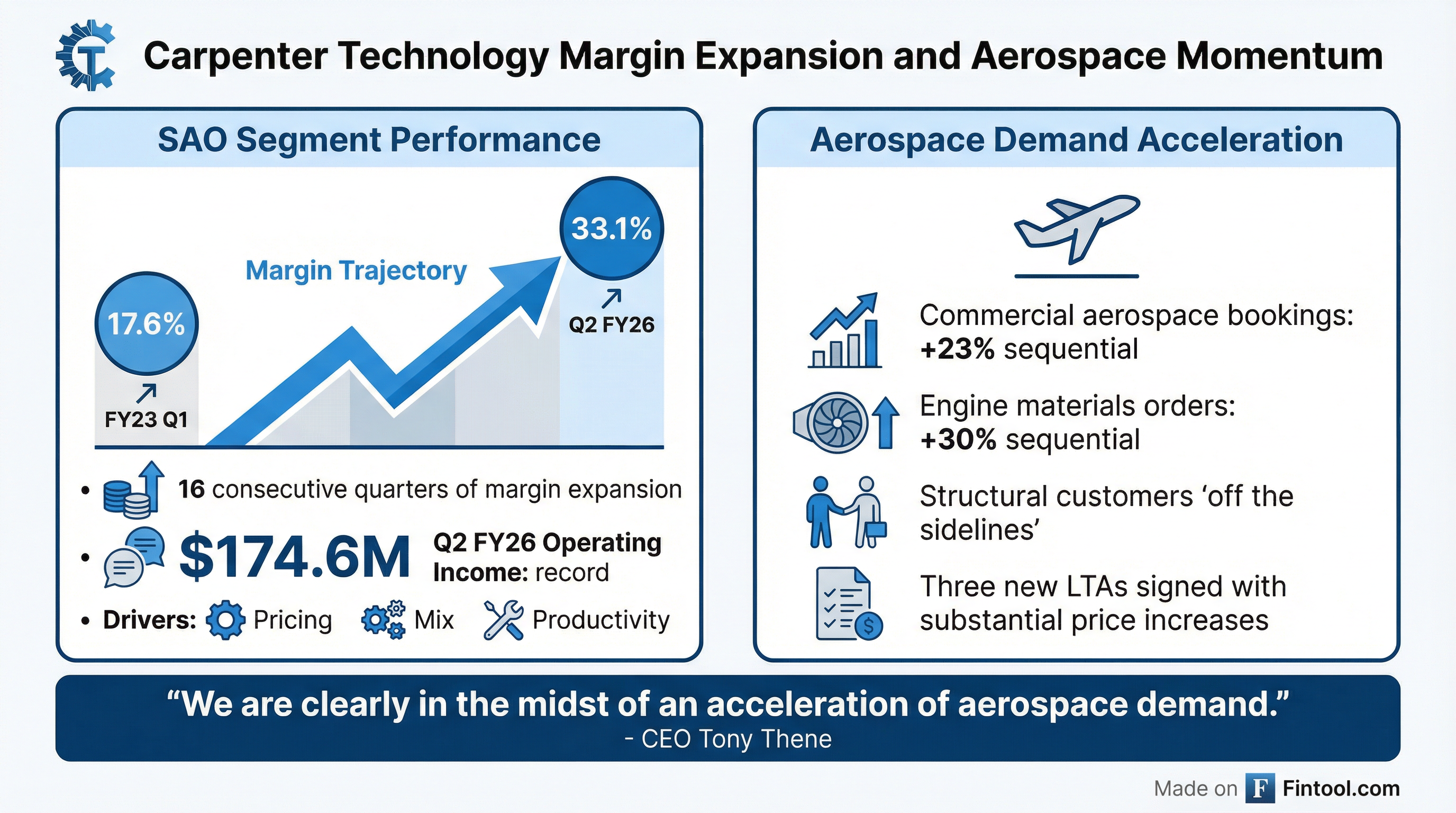
The real story is profitability. SAO segment operating income hit $174.6 million, another all-time record and 29% above last year. This marks the 16th consecutive quarter of margin expansion in the segment, with operating margins reaching 33.1% versus 28.3% a year ago.
 Ask Fintool AI Agent
What Did Management Guide?
Guidance raised. Carpenter Technology increased FY2026 operating income guidance to $680-700 million, up from the prior range of $660-700 million. This implies 30-33% growth over record FY2025 results.
For Q3 FY2026, management provided segment-level guidance:
- SAO segment: $195-200 million operating income (12-15% sequential increase)
- PEP segment: In line with Q2-26 (~$7 million)
- Corporate costs: ~$25 million (implied total company operating income of $177-182 million)
Notably, Thene signaled the FY2027 guidance of $765-800 million may prove conservative: "As this aerospace market continues to accelerate, our focus is not on achieving the fiscal year 2027 guidance. The focus is on exceeding that target."
How Did the Stock React?
Significant selloff despite EPS beat. CRS shares dropped 6.4% on the day, closing at $310.39 after falling from the previous close of $331.61. The stock plunged to an intraday low of $284.16 (down 14.3%) before partially recovering, but ultimately closed near session lows. The selloff appeared driven by the headline revenue miss and concerns about sequential sales decline, despite the record operating income and raised guidance.
The stock has delivered extraordinary returns over the past two years, up approximately 124% from $138.61 (52-week low) to recent highs near $355, reflecting the margin expansion story and aerospace cycle positioning.
What Changed From Last Quarter?
Aerospace Bookings Accelerated
The most significant development was the 23% sequential increase in commercial aerospace bookings, marking the fourth consecutive quarter of order intake increases. Engine material orders jumped 30% sequentially—a critical lead indicator.
Key aerospace dynamics:
- Structural customers "off the sidelines": After sitting out due to Boeing uncertainty, structural customers placed their first large orders in several quarters and signaled "bigger and more urgent" orders to follow
- Boeing milestone: 42 737s built in December, with builds expected to increase faster than deliveries in 2026
- Engine OEMs asking suppliers whether their supply chains have ordered enough material—Carpenter's answer: "In many cases, no"
Three New LTAs at "Substantial" Price Increases
Carpenter signed three new long-term agreements with aerospace customers during the quarter, each with "significant price increases." When asked directly if recent LTA price increases exceeded 30%, CEO Thene responded: "30% is not substantial."
Ask Fintool AI AgentWhat About the Price-Per-Pound Concern?
The sequential decline in reported price-per-pound drew attention, but management emphatically dismissed concerns.
Thene addressed this directly: "If there's some belief that a small sequential price decline... is somehow a red flag, I don't think you could be any more wrong than that. Aerospace-only bookings up 23%. Aerospace engine bookings up 30%. Just completed three aerospace engine LTAs at substantial price increases. I can tell you very clearly we are not or we did not discount premium aerospace products in the quarter."
The price-per-pound variance was attributed entirely to product mix driven by planned maintenance on testing equipment that handles higher-priced aerospace materials.
Segment Performance
SAO (Specialty Alloys Operations) - Record Performance
SAO continues to be the margin expansion engine. The 33.1% operating margin represents continued progress on pricing, product mix optimization, and productivity improvements.
PEP (Performance Engineered Products) - Medical Headwind
PEP results were weighed down by weakness in titanium sales to specific medical distribution customers. However, management noted January order intake for this sub-market was the highest of any month in 2025, suggesting the trough may be in. Additive manufacturing sales increased 54% year-over-year.
Supply-Demand Dynamics: The Bull Case
Thene provided extensive commentary on the structural supply-demand imbalance in nickel-based superalloys:
Demand drivers:
- Aerospace OEM build rates targeting 2,100+ planes/year (30%+ above pre-COVID 2019)
- MRO demand increasing as installed fleet grows and ages
- Defense demand accelerating with advanced platforms requiring more specialty materials
- Space economy growth (commercial satellite launches)
- Power generation/data center buildout competing for same materials
Supply constraints:
- No meaningful capacity additions since 2019 except internal productivity
- Carpenter's brownfield expansion adds only 9,000 tons (~7% of 2019 shipments)
- Highly specialized capacity that is "difficult, if not impossible, to replicate"
- Stringent qualification requirements create barriers
"Taking into consideration increasing demand from several areas, it becomes clear that macro trends support an accelerating explosion of demand for nickel-based superalloy."
Capital Allocation & Balance Sheet
The company completed significant refinancing actions during the quarter: extended maturity of $700 million of existing notes to 2034 with a favorable interest rate, and increased the revolving credit facility from $350 million to $500 million. Total liquidity stands at $730.8 million, including $231.9 million of cash and $498.9 million available under the credit facility.
CapEx is expected to accelerate in H2 FY26 as brownfield expansion construction ramps. Full-year CapEx guidance is $300-315 million, including $175-185 million for the expansion project.
Ask Fintool AI AgentQ&A Highlights
On LTA pricing (Scott Deuschle, Deutsche Bank): Asked if recent aerospace LTA price increases exceeded 30%. CEO response: "30% is not substantial." These are primarily post-COVID renewals.
On structural customers (Gautam Khanna, TD Cowen): Structural customers had significant inventory post-Boeing issues. They're now "coming off the sidelines" with large orders and signaling "bigger and more urgent" orders to follow.
On supply chain positioning (Josh Sullivan, JonesTrading): Engine OEMs are asking Carpenter if suppliers have ordered enough material. In many cases, the answer is no—more orders needed to hit projected build rates.
On customer-funded capacity (Andre Madrid, BTIG): Management declined to comment on specific discussions, noting they've already announced their capacity expansion funded 100% internally.
Key Risks & Concerns
- Defense spending uncertainty: Defense sub-market orders were down materially in Q2 due to government shutdown and budget uncertainty, though this is expected to recover
- Medical distribution weakness: PEP segment impacted by specific titanium customers; visibility has been "elusive" though January orders suggest a trough
- Valuation: Stock up ~124% from 52-week lows; today's 6.4% selloff suggests valuation concerns despite strong fundamentals
Bottom Line
Carpenter Technology delivered exactly what long-term shareholders wanted: record profitability, raised guidance, accelerating demand signals, and continued pricing power. The revenue miss was a mix/timing issue, not a demand problem. The 23% sequential jump in commercial aerospace bookings—in what's typically a quiet holiday quarter—validates the aerospace acceleration thesis.
The supply-demand setup for nickel-based superalloys appears as favorable as management has described. With 16 consecutive quarters of SAO margin expansion, new LTAs locking in "substantial" price increases, and structural customers finally re-engaging, the earnings momentum story remains intact. Management's comment that they're focused on "exceeding" rather than merely achieving FY2027 guidance sets a high bar but reflects genuine confidence in the trajectory.
Related Links: